Radar perception & automotive security
Real-time radar processing, deep learning on low-level sensor data and secure embedded systems
I am a software engineer working on radar perception and automotive security. During my doctoral research at Ulm University I developed self-supervised deep learning methods that fuse low-level radar data with camera images. Since then I have been bringing radar and deep learning into series production vehicles, from a probabilistic radar grid running in real time on an embedded GPU to a deep-learning model that detects obstacles and occupancy around the vehicle. Today I work on embedded and automotive security: cryptographic key provisioning, secure vehicle communication and diagnostics.
Radar perception
Ten years of radar signal processing and deep learning on low-level radar data.
Real-time embedded
CUDA on embedded GPUs, from the first prototype to series production.
Automotive security
Key provisioning, secure vehicle communication and diagnostics.
Research
My passion is in the field of self-learning neural networks applied to low-level sensor data, particularly radar signals. The basic idea is to let the algorithms find patterns and correlations without explicit annotations or manual human interference. This allows for the exploitation of an unprecedented amount of information and makes the environment perception for autonomous systems, especially in unfavorable conditions, more reliable.
To obtain the sparse point cloud representation of discrete reflection centers that most experts are familiar with, conventional radar processing performs a series of laborious calculations depending on various estimates and prone to rejecting vital details of the measurements. It is thus imperative, to collect the data as close to the sensor as possible to retain a maximum of information and let the neural algorithms extract the essentials on their own.
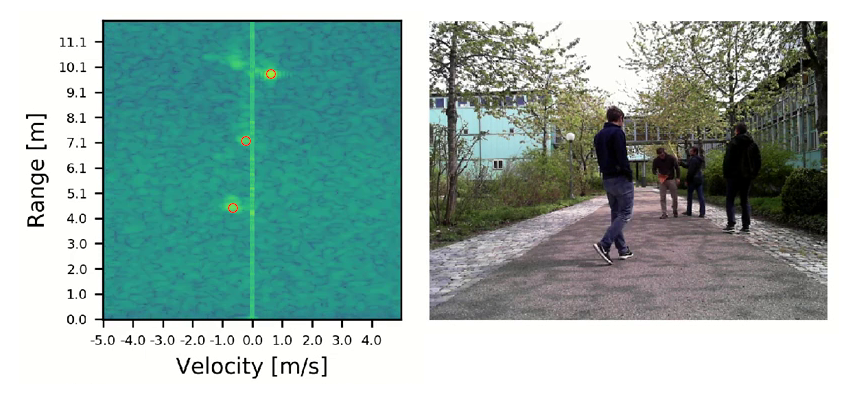
As a case in point, the reflections of the fourth person in the far right back, present in the original recording, were discarded somewhere along the calculations and are absent from the high-level radar point cloud representation. Relying on the lower-level frequency plots instead retains most of the crucial information concealed within the data, including the fourth reflector.
Please have a look at my related projects below and contact me for further details or scientific discussions.


